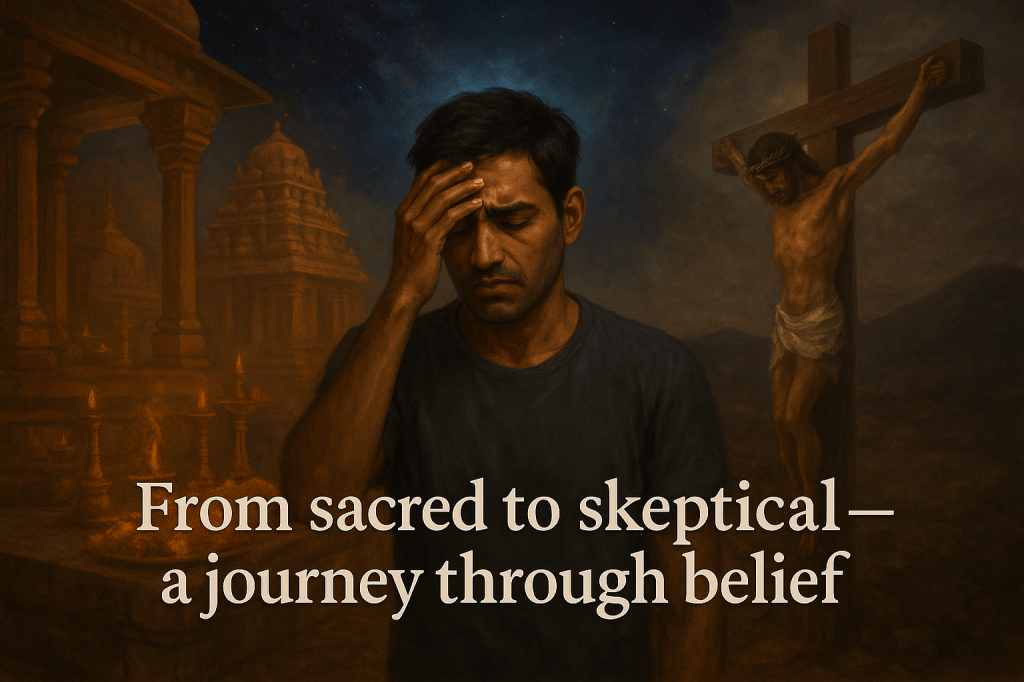
I was born into a Hindu family, surrounded by incense, rituals, temple bells and yes, offerings.
As a child, I saw blood sacrifices during festivals. Goats or chickens were killed to please the gods. At the time, I didn’t question it. It was just tradition. A way to earn favor or avoid punishment from forces we barely understood.

At 18, I converted to Christianity. I was told this religion was different. No more idols. No more meaningless rituals. Just grace, forgiveness, and a loving God who sent His son to die for me.
But then came the blood again.
Except this time, it wasn’t an animal. It was a man.
And not just any man, God Himself, crucified.
At first, it felt sacred. Deep. Divine.
But over time, something didn’t sit right.
Why would an all-powerful God need blood – literal, physical blood to forgive sins?
Why was the centerpiece of Christianity still a sacrifice? Just like the rituals I’d left behind in Hinduism?
Now, at 39, as an ex-believer, I’ve had time to step back. And I see it differently. Whether it’s a goat at a temple or Jesus on a cross, the logic is the same: that someone or something must die to appease the divine.
But is that justice? Is that love? Or is it just ancient superstition dressed up as theology?

The idea that blood is spiritual and necessary for forgiveness is not divine, it’s a superstition born from fear, ignorance, and primitive psychology. And shockingly, even the Bible itself contradicts the very logic of blood atonement that later became central to Christian theology.
Let’s break it down:

What is Blood, Scientifically?
Biologically, blood is not spiritual. It’s a circulatory fluid that:
Delivers oxygen and nutrients.
Removes waste.
Maintains temperature and immunity.
Contains no “spiritual particles” or “sin detectors.”
Blood is tissue, not atonement. There is no evidence that blood carries “guilt” or can “cleanse” morality.

Why Primitive Humans Believed in Blood Sacrifice
Blood = Life
Early people observed that loss of blood meant death. They assumed blood carried the soul or life-force.
Fear of Nature & Gods
They believed that gods caused disease, drought, or disaster. So spilling blood was seen as a way to bribe or calm them.
Guilt Substitution
Sacrificing an animal (or person) was a ritualized way of passing sin or guilt onto something else, a coping mechanism for shame and fear.
Violence as Resolution
Bloodshed was seen as payment for offense. The tribal concept of justice was based on revenge and appeasement, not ethics.

Why Would an All-Knowing God Demand This?
If God is immaterial and infinite, why would He need a material fluid like blood to forgive?
If He is all-loving, why demand violence before showing mercy?
If He is unchanging, why switch from animal blood in the Old Testament to human blood in the New?
God ends up looking more like a bronze-age deity than a timeless being.

Here’s the Contradiction: Can One Man Bear Another’s Sin?
Christianity is built on substitutionary atonement—that Jesus died to pay for others’ sins.
But the Old Testament says the opposite:
Ezekiel 18:20
“The soul who sins is the one who will die. The son will not share the guilt of the father, nor will the father share the guilt of the son.”
Deuteronomy 24:16
“Parents are not to be put to death for their children, nor children put to death for their parents; each will die for their own sin.”

So according to the very same Bible, no one can bear someone else’s guilt.
Which means the whole idea of Jesus dying for others’ sins is unbiblical by earlier standards.
It’s a contradiction. Either:
God changed His mind,
or ancient people misunderstood God,
or the Christian theology was patched onto old Jewish ideas and doesn’t hold up when examined together.

Humans, Sin, and the Universe
Humans are one species on one planet in a vast, indifferent universe.
“Sin” is a religious concept, not a scientific reality.
To say that the entire cosmos was cursed because Adam ate a fruit or that Jesus’ blood cleansed galaxies is to exaggerate our cosmic relevance based on tribal myth.
It’s not humility. It’s cosmic narcissism rooted in fear and control.
“God Sacrificed Himself to Forgive?”
The Christian claim:
“God loved the world so much He gave His only son…”

But:
Why does an omnipotent God need to satisfy Himself with death?
Why not just forgive like a truly powerful being could?
Why play out a divine soap opera involving betrayal, torture, and crucifixion just to forgive what He could undo in an instant?
This isn’t love. This is ritualized abuse turned into doctrine.

Final Thought:
“Without the shedding of blood, there is no forgiveness” (Hebrews 9:22)

This is not morality.
This is not love.
This is archaic violence glorified as divine wisdom.
We now know better.
Science tells us what blood is.
History tells us why blood sacrifice happened.
Logic tells us a real God wouldn’t need it.

Posted in

Share your thoughts