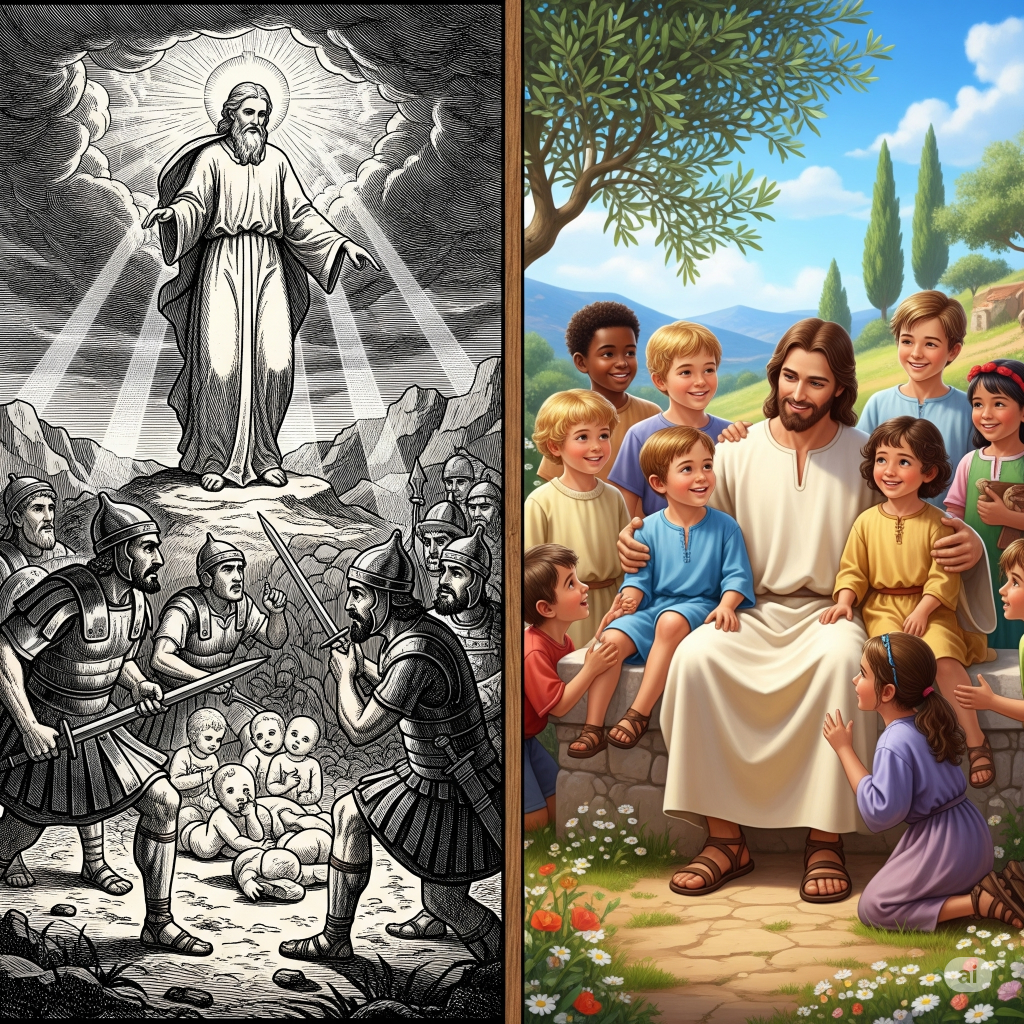
I used to ignore the parts of the Bible that made me uncomfortable.
You know the ones commands to slaughter entire nations, endorse slavery, punish children for their parents’ sins. I’d skim past them, chalk them up to “Old Covenant times,” or tell myself, “God’s ways are higher than mine.”
But that voice the one that whispered “this doesn’t feel right” never really went away.
For years, I carried a deep conflict between what I believed about God (loving, good, just) and what I actually read in the Bible. And the more I studied, the harder it became to reconcile the two.
Why did the God of love sound so much like a tribal warlord?
Why did morality seem to get better over time not because of God, but in spite of Him?
Eventually, I had to face the question head-on:
Was it really God changing over time or just human morality evolving, and dragging our idea of God along with it?
Seems God didn’t evolve. Our idea of God did.
1. Early Humans Weren’t “Given” Morality — They Developed It
Like technology, morality is a human invention. It wasn’t dropped into our laps from the sky, it evolved with us.
Early humans didn’t think in terms of “right” and “wrong” the way we do now. They thought in terms of survival:
Protect the tribe
Obey authority
Kill enemies
Silence dissent
The idea of loving your enemy or treating women equally wasn’t just radical it was nonsensical in their world.
So if God was really teaching morality from the beginning, why did it take thousands of years to reach even the basics of human rights?
And doesn’t that make you pause that a supposed all-wise God couldn’t even get the fundamentals right?
2. The Old Testament Reflects Ancient Tribal Morality — Not Divine Standards
The more I read Scripture deeply and honestly, the more I saw this:
God supposedly commands things that would make even a warlord blush:
“Slaughter every man, woman, and child” (1 Samuel 15:3)
“Your slaves are your property” (Leviticus 25:44–46)
“If a man rapes a virgin, he must marry her” (Deuteronomy 22:28–29)
I tried every apologetic response I could find. I twisted myself in theological knots to “explain” these verses.
Have you done the same?
Have you ever tried to justify the unjust simply because it was in the Bible?
At some point, I had to ask myself:
What if the problem isn’t me misunderstanding God? What if the problem is that these verses weren’t from God at all?
Maybe ancient men just wrote what they believed and slapped “God said it” on top of their tribal laws.
3. Was Jesus There in the Old Testament? If So, It Doesn’t Make Sense
If Jesus is God…
If Jesus is “the same yesterday, today, and forever”…
If Jesus and the Father are “one” (John 10:30)…
Then where was Jesus during the Old Testament?
Because if the God of the Old Testament is the same as Jesus, then Jesus was there when:
- Babies were being smashed on rocks (Psalm 137:9)
- Entire tribes were slaughtered without mercy
- Women were taken as war prizes
- Slaves were treated like property
So what was Jesus doing during all that?
Just… watching?
Agreeing?
Nodding silently as Yahweh commanded genocide?
It honestly wrecked me to even ask that.
How could the Jesus who said “love your enemies” also be the one overseeing enemy babies being slaughtered in the womb?
And if He wasn’t okay with those things, why didn’t He intervene?
Why not show up then and say, “Love one another,” instead of waiting thousands of years?
It makes you wonder: Is Jesus really the same God of the Old Testament? Or have we, again, created a more lovable version of Him as our morality evolved?
4. Why Does “God” Change in the Bible?
By the New Testament, the tone shifts drastically. Suddenly, God says:
“Love your enemies”
“Do not resist an evil person”
“Blessed are the peacemakers”
What changed?
Not God. Human culture.
Jews were now under Roman occupation
Greek philosophy had spread ideas of virtue and compassion
The world was slowly outgrowing tribal brutality
And maybe you’ve seen it too. This slow unraveling of beliefs we once thought were divine:
God became more loving because humans became more humane.
Isn’t that telling?
5. If God Is Perfect, Why Does His Morality Evolve?
This was the final nail in the coffin for me.
If God is truly:
Timeless
Perfect
All-wise
…then His moral commands should be timeless, perfect, and wise. But they’re not.
And maybe you’ve noticed this too, the contradictions, the moral discomfort, the sermons that make you wince.
And maybe you’ve seen it too. This slow unraveling of beliefs we once thought were divine:
From vengeance to mercy
From tribalism to inclusion
From patriarchy to equality
That’s not divine revelation. That’s human progress.
Final Thought: God Didn’t Grow Up — We Did
Leaving faith was not easy. My entire world had been built around the idea of a loving, moral God. But what I saw in Scripture especially the Old Testament didn’t match that picture.
It took me 21 years to admit it, but I finally did:
The God I believed in was created in the image of evolving human values not the other way around.
And that’s not a loss. That’s growth.
Because if we’re no longer chained to ancient commandments, maybe we can start asking better questions ones based on empathy, reason, and shared humanity.
What kind of morality would you build if you started from scratch, without fear of divine punishment?
 leavingfaithbehind.com
Share your thoughts