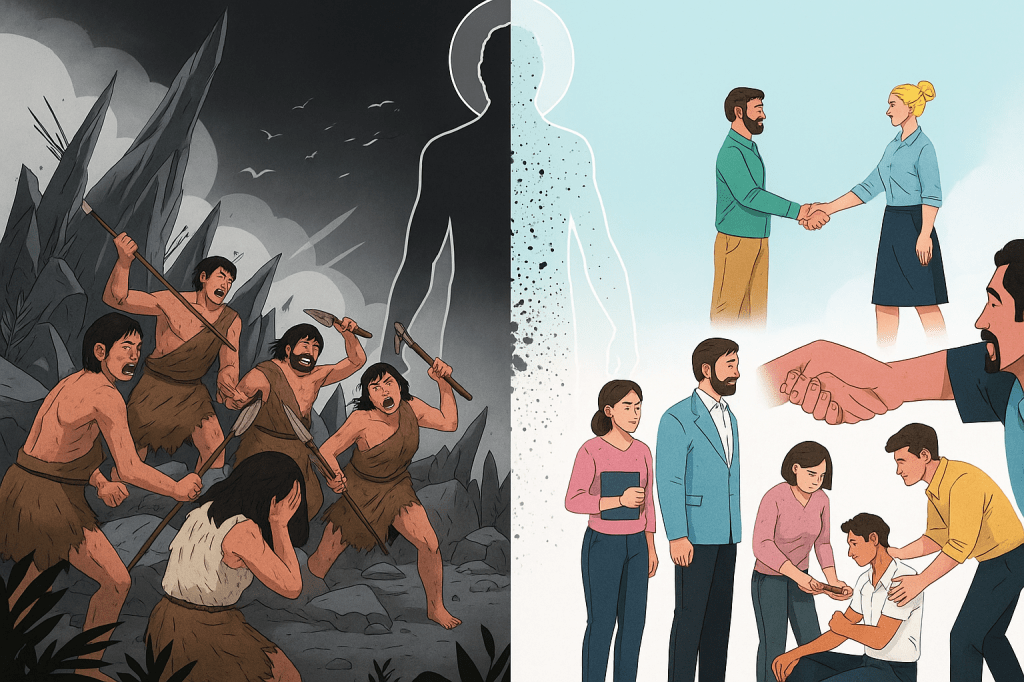
One of the biggest questions that haunted me on my journey away from faith was the problem of morality. I often heard the familiar claim that morality comes from God, that without Him, there would be no standard of right and wrong. But the more I thought about it, the more I realized this didn’t add up.
If morality truly comes from God, why were primitive humans so incredibly immoral? Archaeology and anthropology paint a pretty dark picture: early humans practiced infanticide, slavery, ritual killings, and tribal warfare at levels we’d find horrifying today. If God had written morality on their hearts, why was cruelty the default?
What makes far more sense to me now is that morality evolved with us. In the beginning, survival mattered more than kindness. But as humans started living together in bigger groups, cooperation and empathy gave us an advantage. Simply put, tribes that learned to treat each other better thrived. Morality wasn’t handed down, it was built up, slowly, painfully, generation by generation.
And then there’s scripture. When I look back at the Bible, I can’t help but notice that its “morality” mirrors the same primitive ethics of the time: genocide, slavery, stoning, women treated as property. If God’s morality is eternal and perfect, why does it look exactly like Iron Age morality? It feels much more like humans wrote their morality into God, not that God wrote His morality into humans.
The strongest evidence for me is how morality has changed. If it truly came from God, it should have been fixed from the start. But instead, it shifted: slavery went from being divinely ordained to universally condemned; women went from silent property to equal citizens; compassion expanded from just our tribe to the whole of humanity, even animals. That looks a lot like moral evolution, not divine revelation.
And the hardest question of all: If God designed morality, why delay it? Why let countless generations of humans suffer in darkness before dropping a few moral rules? Why not give primitive humans the same clarity we claim to have now? That delay makes no sense in a world with a moral God, but it makes perfect sense in a world where morality is a human invention, constantly being refined.
The truth is, morality is our responsibility and need not wait for God. If man was so ignorant in those days, why was there no so-called objective morality that could have taught him from the beginning? Why do people today have better morals and understanding? And why was God portrayed as so brutal in the Old Testament, reflecting the exact mindset of a primitive human? To me, this only implies human thought, not divine words.
If objective morality truly exists, the evidence of history shows it hasn’t been fixed, it has evolved. What once was accepted (slavery, genocide, women as property) is now condemned. That means either:
- God’s morality also evolved — which contradicts the idea of a perfect, unchanging God. Or,
- Morality was never God’s to begin with — it was always a human idea, refined as our understanding and empathy grew.
Either way, the traditional picture of God doesn’t hold up. If God’s morality changes, then He isn’t eternal and perfect. If it doesn’t change, then the “objective morality” of the Bible was nothing more than human projection of their primitive ethics.
For me, realizing this was liberating. It means morality is ours. It’s something we built, something we can continue to improve, and something we don’t need a divine lawgiver to justify. We’ve come a long way from the cruelties of the past, and that progress wasn’t because of God, but because of us.
 leavingfaithbehind.com
Share your thoughts