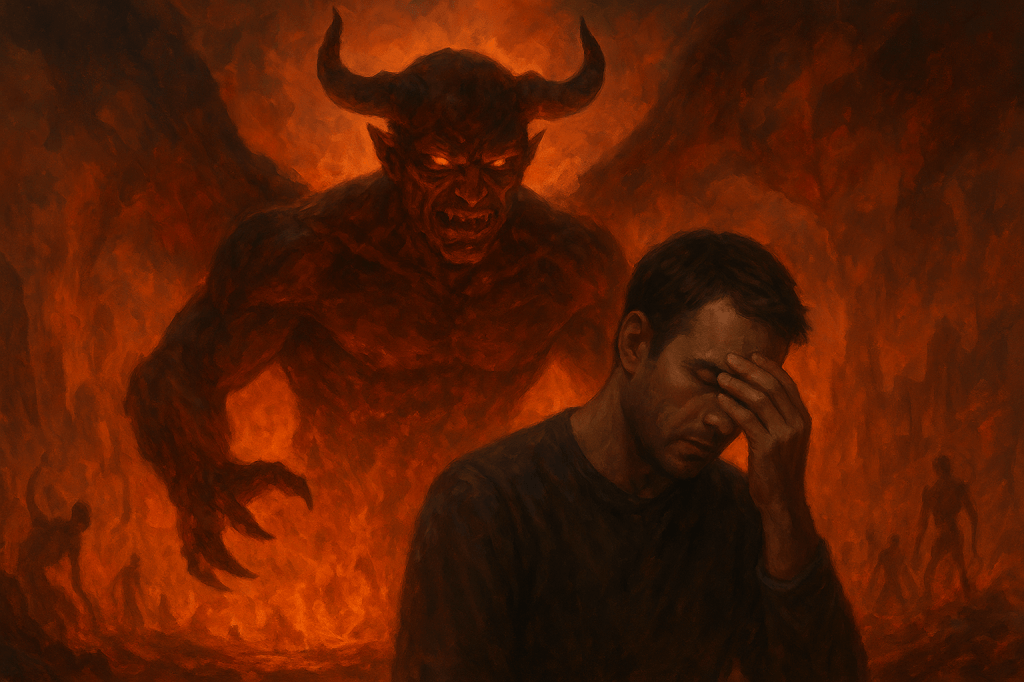
Escaping the Fear of Hell: Understanding Where It Really Came From
I didn’t grow up fearing hell. I came from a Hindu background where the afterlife was seen very differently – karma, rebirth, cycles of life, but not eternal fire.
When I became a Christian at 18, I didn’t fear hell either. I truly believed and trusted that the finished work of Jesus on the cross for my sins had saved me from condemnation. I was no longer the old human who was guilty. I was a new creation, blameless in God’s sight.
Because of that, I surrendered my life to Christ. I wanted him to be the center of every moment. I held tightly to the promise of scripture: “There is now no condemnation for those who are in Christ Jesus.” My focus was on eternal life, not destruction or torment.
But everything changed when tragedy struck my family. My father was killed in a sudden road accident.
I couldn’t digest it. I couldn’t understand why God didn’t save him while he was alive. Worse, a darker thought tormented me: “What if my father is in hell right now?”
According to what I had been taught in the Bible, anyone who didn’t belong to Jesus would go to hell. There was no middle ground. My father was a good man, far better in many ways than I was before I converted. But as a non-Christian, he was “lost.”
That thought left me in despair. I kept asking:
- How could Jesus—my God—torment my father forever and ever?
- Why didn’t God give him another chance, at least for my sake?
- Why not allow a disease, something that gave him time to repent, instead of a sudden accident at just 55?
These questions haunted me. Not because of random doubts, but because the Bible itself had taught me that hell was real and unavoidable for those who didn’t belong to Jesus.
Still Believing After Loss
Yet even in my grief, I made peace with the thought that, although I couldn’t understand it now, Jesus would explain it to me in the afterlife. I leaned on the old saying: “God’s ways are mysterious.” That trust allowed me to keep going.
For another 14 years after my father’s death, I remained a Christian. I married a Christian woman like me, and together we raised two beautiful daughters in the same faith. On the outside, I looked like a man rooted firmly in Christ.
But inside, questions remained buried. And eventually, they began to surface again, this time, stronger than ever.
Discovering the Origins of Hell
As I began to truly seek the truth about my faith and the Bible, I discovered something shocking: the Old Testament doesn’t teach eternal hellfire.
The Hebrew word Sheol – often mistranslated as “hell” just means the grave. It’s where everyone goes, righteous or wicked, with no torment attached.
The idea of eternal punishment evolved much later, shaped by cultural influences. And the more I studied, the clearer it became that hell was never part of God’s original message. Here’s why:
- The Old Testament has no eternal hell. The prophets, Moses, David, and even the Law never warned about eternal fire. Their focus was always on blessings or judgment in this life.
- Jesus’ “Gehenna” wasn’t a literal place of torment. Gehenna was a valley outside Jerusalem where trash and carcasses were burned. It was a powerful image of destruction, not eternal torture.
- Paul never teaches hell. Paul, who wrote much of the New Testament, speaks about death, resurrection, and judgment, but never about an eternal hell of torment. If it was so central, why didn’t he mention it?
- Revelation’s “lake of fire” is symbolic. Revelation is an apocalyptic vision full of symbols (dragons, beasts, stars falling). It wasn’t meant to be taken literally. The “lake of fire” is imagery, not geography.
- The Bible contradicts itself on the fate of the wicked.
- Some verses say they’ll be destroyed (Matthew 10:28).
- Others say they’ll be burned up like chaff (Malachi 4:1–3).
- Others talk about outer darkness or separation.
- If hell were real and eternal, why is the Bible so inconsistent?
- Eternal torment makes no sense with God’s justice. Finite sins in a short lifetime don’t deserve infinite punishment. That’s not justice, it’s cruelty.
- Hell was used as a control mechanism. Early church leaders admitted that fear kept people obedient. Tertullian even wrote that the spectacle of unbelievers burning would be part of the “joy of the saved.” This wasn’t love, it was fear-based power.
- Other religions have their own “hells.” Hinduism, Buddhism, Islam, and Zoroastrianism all developed afterlife punishments independently. That shows hell is a recurring human invention, not a revealed universal truth.
- Historical reinforcement: Augustine systematized the doctrine of eternal torment in the 4th century. By the Middle Ages, Dante’s Inferno and church art turned it into vivid imagery that terrified believers. What people picture as “hell” today owes more to literature and paintings than to scripture.
When I put all of this together, it was undeniable: hell wasn’t revealed by God, it was a cultural evolution.
Finding Peace
When I finally saw this, everything shifted.
The Bible’s teaching on hell is not consistent. The Old Testament doesn’t have it. The New Testament absorbs outside influences. The church systematized it.
Which means my father is not in eternal flames. He’s simply gone. Death is death, no torment, no fire, no eternal suffering.
That realization gave me peace. I no longer carry the unbearable weight of imagining my father in eternal torture. He lived, he died, and now he rests.
And in a way, so do I.
Final Thought
For me, the fear of hell wasn’t about my own fate, it was about my father’s. Christianity taught me he was lost forever, and that thought tore me apart inside. For years I tried to silence it with trust in God’s “mysterious ways,” but the fear never truly left until I uncovered the truth.
By understanding the origins and evolution of hell, I could finally let go. I discovered that hell is not a divine reality, but a human invention, a doctrine shaped by cultures, translated through languages, and enforced by religion.
Now, instead of despair, I have peace. My father isn’t burning somewhere. He’s just gone. And that’s enough.
👉Question for readers: Has the doctrine of hell ever made you question the fate of loved ones? How have you found peace in letting go of that fear?
 leavingfaithbehind.com
Share your thoughts