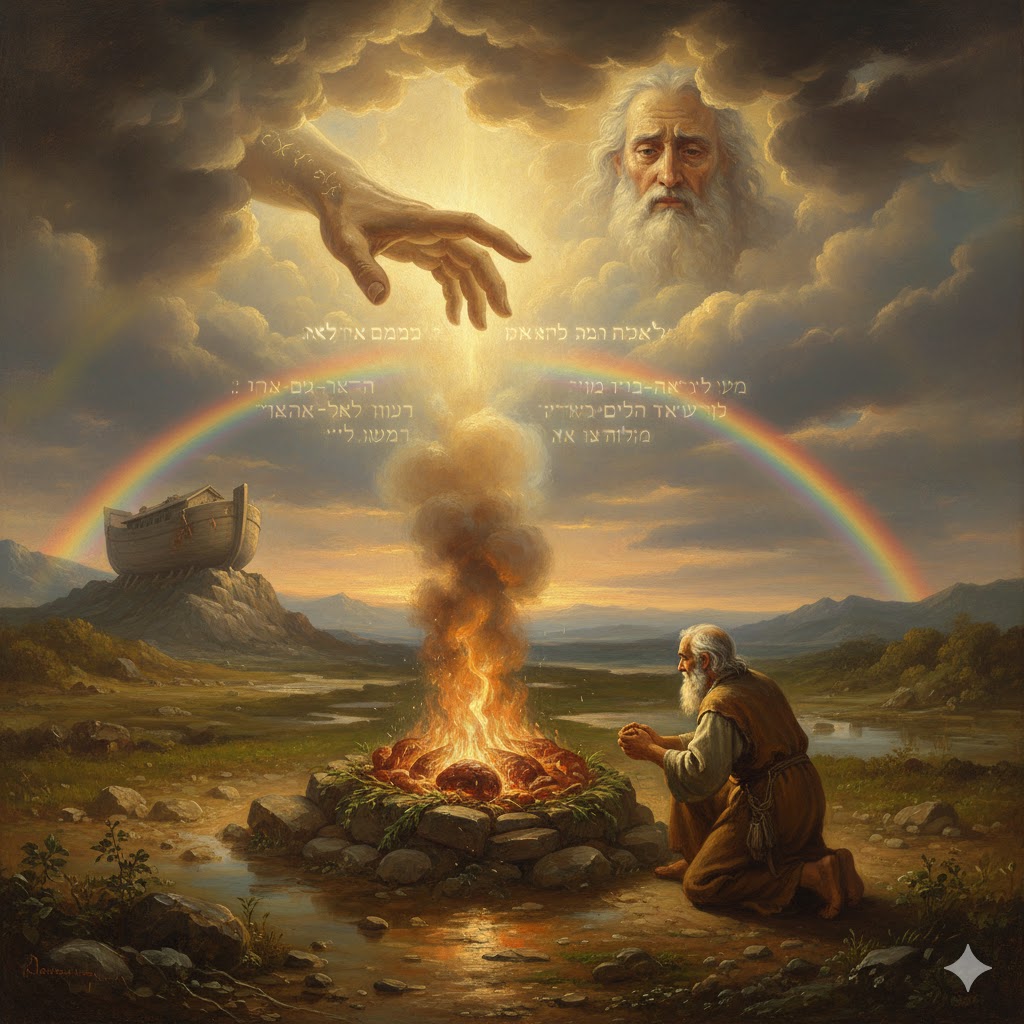
There was a time I accepted the story of Noah’s Ark with childlike trust. I believed it as sacred history, an act of divine justice carried out by a perfect, all-knowing God. But years later, when I returned to the text with honesty, curiosity, and the freedom to question, the pieces no longer fit the way they once did. What used to inspire faith now stirred doubt, and what once looked like the work of a flawless God began to look like the work of ancient human storytelling.
This is not written to mock belief, but to examine a story I once cherished. If truth matters, questions should never be feared.
1. What the Bible Actually Says (Genesis 6–9)
The flood narrative claims that humanity became so wicked that God decided to wipe out nearly all life on earth. The text emphasizes regret, anger, destruction, and finally a covenant symbolized by a rainbow.
Genesis 6:5–7
“The LORD saw how great the wickedness of the human race had become on the earth… The LORD regretted that he had made human beings on the earth, and his heart was deeply troubled. So the LORD said, ‘I will wipe from the face of the earth the human race I have created.’”
Genesis 6:17
“I am going to bring floodwaters on the earth to destroy all life under the heavens.”
Genesis 9:13
“I have set my rainbow in the clouds, and it will be the sign of the covenant between me and the earth.”
At face value, many believers see justice, mercy, and a fresh start. But when we examine the claims closely, unsettling contradictions emerge.
2. An All-Knowing God Who “Regrets”?
Regret only makes sense when the future is unknown. Yet the Bible also teaches that God is omniscient, knowing the end from the beginning. The flood story clashes with that theology:
| Christian Claim | Flood Narrative Problem |
|---|---|
| God is all-knowing | Then He knew humans would become “wicked” |
| God is perfect | Then He shouldn’t need a do-over |
| God doesn’t change | Yet He changes His mind and wipes out creation |
| God is love | Yet He kills every child, infant, and animal |
A God who regrets His own creation behaves like a human who made a mistake, not an infallible deity.
3. A Violent Solution That Solves Nothing
Even after the destruction, the story admits that humans have not changed:
Genesis 8:21
“Every inclination of the human heart is evil from childhood.”
The flood achieves nothing. Evil continues. Humanity remains the same. A perfect, all-powerful God could have chosen:
- Moral persuasion
- Transformation of hearts
- A targeted response (not global slaughter)
- Education, patience, or growth
Instead, He chooses global annihilation, killing babies, animals, and pregnant mothers. This is collective punishment, something we would call immoral today. If another religion described their god doing this, Christians would reject that god instantly.
4. Noah, the “Righteous Man”… Who Gets Drunk and Curses His Son
After the flood, the story descends into strangeness:
Genesis 9:20–21
“Noah, a man of the soil, proceeded to plant a vineyard. When he drank some of its wine, he became drunk and lay uncovered inside his tent.”
Noah, supposedly the most righteous man on earth gets drunk, lies naked, and then curses his son’s descendants. This is the moral reset of humanity? This is the best candidate for a new beginning?
The story reads more like dysfunctional ancient family drama than divine wisdom.
5. The Ark and Scientific Absurdity
When we compare the ark story to what we now know about the world, its impossibility becomes undeniable.
A. Species Count
Modern biology identifies 8.7 million species (land + sea). Even if we only consider land animals, insects, and birds, millions of species would need space, climate control, food, air, and waste management.
How did:
- Kangaroos travel from Australia to the Middle East before the flood?
- Penguins survive the Middle Eastern heat?
- Llamas, sloths, pandas, koalas, polar bears, and toucans reach the ark?
- And then return to isolated continents after the flood?
No believer has ever provided a coherent answer to this.
B. Genetics and Inbreeding
Two animals cannot repopulate a species without severe genetic collapse. Basic genetics makes the ark story impossible.
C. Food, Freshwater, and Waste
One year on the ark would require:
- Thousands of tons of food
- Clean water for millions of species
- Removal of tons of manure daily
Eight humans cannot manage that. Not even close.
D. Parasites and Pathogens
Did Noah carry:
- Malaria?
- Mosquitoes?
- Tapeworms?
- Rabies?
Were these part of God’s “good creation” too?
E. Ship Engineering
Marine engineering studies show a wooden ship of ark dimensions would break apart in rough seas.
6. The Rainbow: Ancient Ignorance, Not Divine Symbol
The Bible claims God placed a rainbow in the sky as a new covenant. But a rainbow is simply:
- Sunlight
- Refracted through water droplets
- Split into a spectrum by dispersion
Rainbows existed for millions of years before humans. The story reflects ancient meteorology ignorance, not divine revelation.
7. The Flood Story Is Not Original: Gilgamesh Came First
The Epic of Gilgamesh was written long before Genesis and it contains nearly identical elements:
| Gilgamesh (older) | Genesis (later) |
|---|---|
| Gods angry at humans | God angry at humans |
| One chosen man | One chosen man |
| Build a boat | Build a boat |
| Bring animals | Bring animals |
| Global flood | Global flood |
| Boat rests on mountain | Boat rests on mountain |
| Release birds | Release birds |
Genesis is not unique. It is a retelling of an older Mesopotamian myth.
8. The Moral Crisis: Is Slaughter Divine?
If a modern leader flooded the world to kill every man, woman, child, animal, and infant, christians would call him a monster.
But when the Bible describes it, we’re expected to call it “good” and “just.”
Morality should not change just because the killer is given a different title.
9. The Questions That Finally Broke My Silence
Eventually, I could not avoid these questions:
- How can a perfect God regret His own creation?
- Why kill every child and animal instead of addressing human behavior?
- Why is the story copied from older myths?
- Why would God need a rainbow reminder?
- How do millions of species fit on one boat?
- Why did evil remain after the flood if the flood was the solution?
- Why choose Noah, who soon gets drunk and curses his own family?
The more I asked, the less the story resembled divinity.
10. Conclusion: The Story Is Human, Not Divine
Christians describe God as:
- All-knowing
- All-powerful
- Perfect
- Moral
- Loving
- Unchanging
But the flood narrative reveals a character who is:
- Surprised
- Regretful
- Vengeful
- Impulsive
- Unjust
- Ineffective
That is not the mind of a perfect God. It is the mind of ancient men writing with limited knowledge, limited morality, and limited imagination.
I didn’t walk away from this story because I wanted to reject God. I walked away because I chose honesty over fear and evidence over tradition. Once I allowed myself to think, the illusion fell apart.
If God is real and truth is sacred, then asking hard questions should never be a sin.
 leavingfaithbehind.com
Share your thoughts