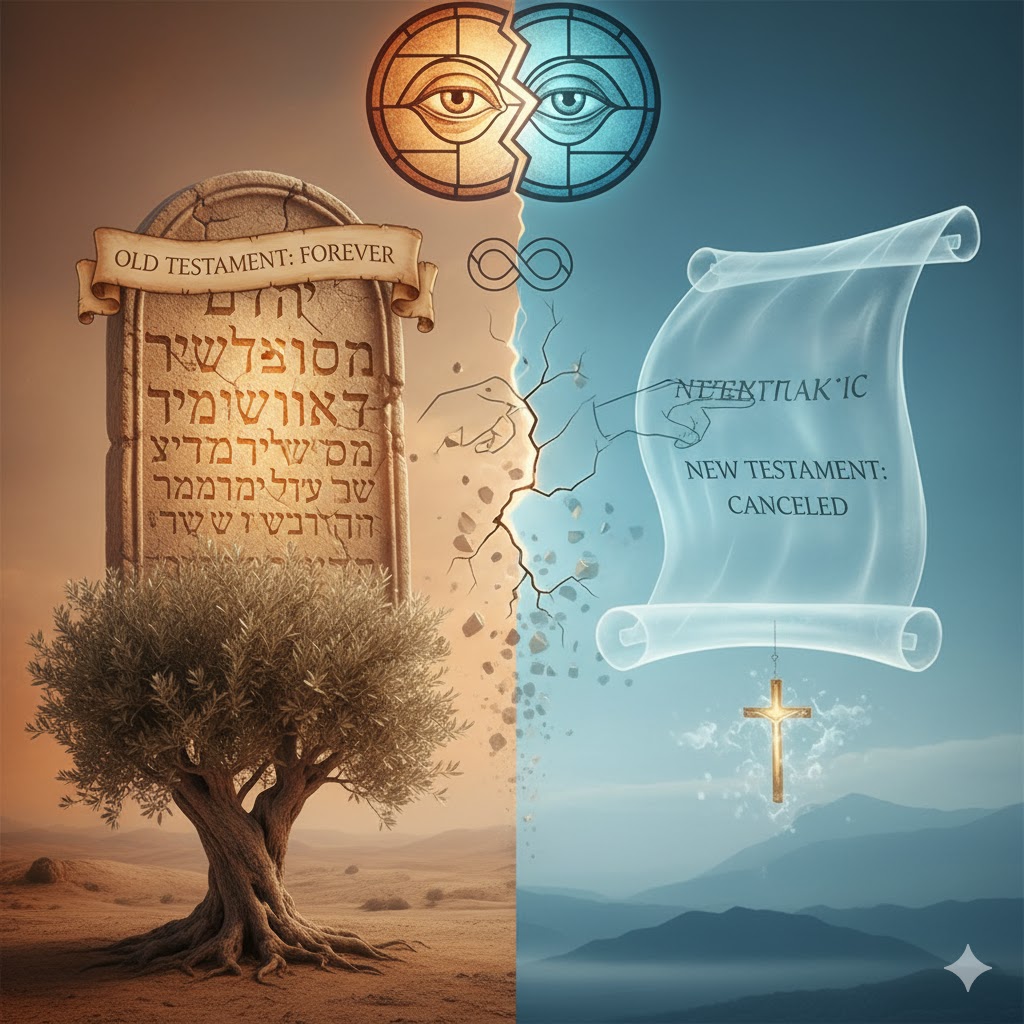
For years, I never thought to question it. The Bible always said God’s covenants and laws were everlasting, “a statute forever,” “throughout your generations,” “an everlasting covenant.” Those words sounded final, unchangeable, eternal.
But then I started noticing something strange: when the New Testament arrived, suddenly “forever” didn’t mean forever anymore.
The Old Testament’s Clear Claim, “Forever” Meant Forever
If you read the Hebrew Scriptures at face value, you’ll notice something: God never said His laws were temporary.
- “The Sabbath shall be a sign between Me and the children of Israel forever.” Exodus 31:16–17
- “It shall be a statute forever for you.” Leviticus 16:34
- “He remembers His covenant forever, the word which He commanded to a thousand generations.” Psalm 105:8
The feasts, the priesthood, the sacrifices, the temple rituals, all were said to be permanent markers of the covenant between God and Israel.
And nowhere, absolutely nowhere, does the Old Testament say:
“You’ll follow these laws until a Savior comes.”
If that were God’s plan, it would have been simple enough to say it. Yet it’s completely missing. Every time the Law is mentioned, it’s described as something Israel must keep “forever and ever.”
That sounds pretty straightforward. Until the New Testament shows up.
The New Testament’s Redefinition – A Quiet Rewrite
Then Paul and others came along preaching that the old covenant was obsolete.
- “Christ is the end of the law.” Romans 10:4
- “The law was our tutor until Christ came.” Galatians 3:24–25
- “By calling this covenant ‘new,’ He has made the first one obsolete.” Hebrews 8:13
Wait, obsolete? The same covenant God Himself called everlasting?
When you read the Old and New Testaments side by side, it’s almost as if the second group of writers didn’t understand what forever means, or rather, they had to reinterpret it to make their theology work.
The Word Game – How “Forever” Was Rewritten
In Hebrew, the word for “forever” is ‘olam’, it means lasting, perpetual, eternal.
Christian apologists later argued that “forever” just meant “for a long age,” or “until God decided otherwise.”
But that’s reading the Bible backward, inserting later Christian ideas into older Jewish texts that never implied any expiration.
When Moses said “forever,” the people of Israel understood it exactly as it sounds for all generations, not until Paul writes Galatians.
Why This Matters
This isn’t a small linguistic issue.
It’s about whether God changes His mind or not.
If God’s laws were eternal, why did they suddenly expire?
If they weren’t eternal, why call them that in the first place?
It’s like a manufacturer promising a “lifetime warranty,” then quietly updating the fine print after the product fails.
The Old Testament God seemed to take pride in being unchanging:
“I, the Lord, do not change.” Malachi 3:6
Yet the New Testament writers tell us that the old system is now outdated, that a “new covenant” has replaced it. If that’s true, then God did change His mind, and that raises questions about His consistency and credibility.
The Missing Clause That Never Existed
If the Law was meant only “until the Messiah came,” shouldn’t there at least be a single verse saying so?
But no prophet ever hinted that the Torah would expire.
In fact, the prophets envisioned those same laws continuing in the future:
- Zechariah 14 describes nations keeping the Feast of Tabernacles in the Messianic age.
- Isaiah 66 speaks of people keeping Sabbath even in the new heavens and new earth.
So if the Messiah was supposed to end the Law, the prophets didn’t get the memo.
A Simple Thought
Maybe the New Testament writers weren’t revealing new truth, maybe they were reinterpreting old words to fit a new story.
When they couldn’t reconcile “forever” with their theology, they simply changed what “forever” meant.
And once you start noticing that pattern, reinterpretation whenever things don’t fit – you begin to see how flexible “divine revelation” really is.
Closing Reflection
For me, this realization wasn’t about rejecting God outright.
It was about noticing the cracks in what was once presented as a flawless, eternal truth.
If a book says one thing forever and then reverses it later, maybe the problem isn’t with me for questioning it.
Maybe the problem is with calling it inerrant in the first place.
Because if “forever” doesn’t mean forever,
then what does?
 leavingfaithbehind.com
Share your thoughts