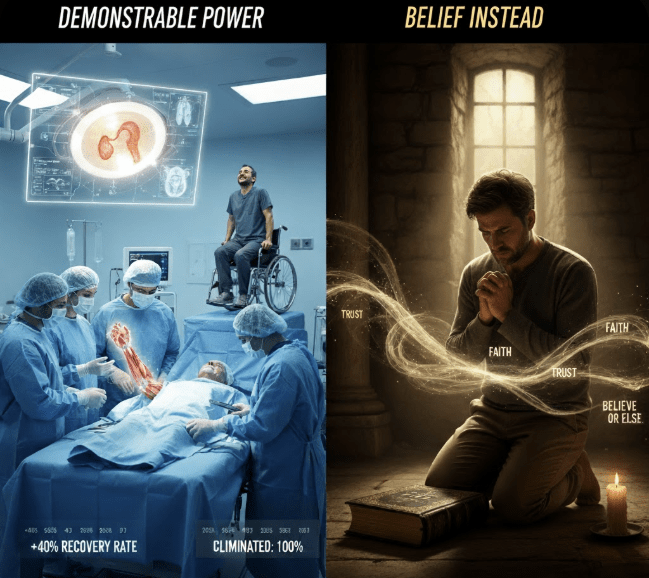
One thing that bothered me for years, long before I left the faith was this simple question:
If Jesus dying and resurrecting is an actual historical fact, then why does the Bible say you must believe it to be saved?
If something is objectively true, like gravity or oxygen, you don’t need to “believe” for it to work. My belief doesn’t keep me from falling off a building. My faith doesn’t decide whether water will boil at 100°C. Facts don’t need your trust, they just are.
Yet Christianity doesn’t work like that.
It doesn’t say: “Here is the proof, observe the evidence, test it for yourself.”
Instead, it says: “Believe or else.”
And that raises some uncomfortable questions.
1. If the resurrection is a fact, why must belief be a condition?
Imagine this:
If Jesus truly resurrected in history, in a verifiable, objective way, then salvation should simply be based on that being true, not on my mindset about it.
But what does the Bible say?
- “Without faith it is impossible to please God.” (Hebrews 11:6)
- “Whoever believes… shall be saved.”
- “If you do not believe, you will die in your sins.”
Notice something?
The emphasis is never on proof, always on belief.
Almost as if the story collapses without the psychological reinforcement of faith.
2. Why no measurable, repeatable miracles today?
If the Christian God is real and Jesus said believers would do even greater works than him, then the world should be overflowing with verifiable supernatural events.
Not vague stories.
Not “my aunt felt warmth during prayer.”
Not “healed arthritis” with no medical record.
But actual, repeatable, ICU-level miracles like:
- severed limbs growing back
- cancer disappearing on live scan
- blind people receiving visible retinas
- paraplegics standing up and running
- pastors clearing out hospital wards
If prayer worked in a measurable way, hospitals would run statistics:
“Christian prayer increases recovery rate by 40%.”
But that has never happened.
Not once. Not in any controlled setting.
The only “miracles” we hear are the ones that conveniently can’t be tested.
3. Jesus’ promises don’t match reality
This is the awkward part.
Jesus didn’t give ambiguous metaphors about miracles.
He gave literal claims:
- believers will heal the sick
- believers will drink poison and not be harmed
- believers will take up snakes without injury
- believers will move mountains
- believers will do greater miracles than he did
Now think honestly
Do we see even 1% of this today among normal Christians?
Even pastors, prophets, evangelists, the “spiritual elites” barely manage a headache cure, let alone raising the dead.
If these promises were real, believers would be the most medically, physically, and scientifically unstoppable group on earth.
But what do we get instead?
“Please believe… even though nothing happens.”
That’s not divine power.
That’s marketing.
4. Faith becomes a substitute for evidence
This is the heart of the issue.
Christianity doesn’t run on power or proof.
It runs entirely on belief.
Take away faith, and the system collapses.
There’s no fallback.
So the Bible repeatedly reinforces belief as the ultimate virtue:
- Believe or perish.
- Believe or go to hell.
- Believe and you’ll receive.
- Believe and miracles will follow.
But the “miracles” don’t happen, so the belief becomes the product.
Faith becomes the shield against doubt, the glue holding everything together, the answer to every unresolved contradiction.
Christianity promises power, but delivers belief.
It promises miracles, but delivers metaphors.
It promises evidence, but demands faith.
5. Final Thought – Why does the message rely on blind faith?
Because if something is verifiable, falsifiable, and measurable, it doesn’t need faith to sustain it.
You don’t “believe” in antibiotics.
You don’t have “faith” in gravity.
You don’t “trust” electricity.
They work whether you believe or not.
But Christianity requires belief because the claims are not demonstrable in the real world.
The message survives only when people are told:
“Don’t ask for evidence.
Just believe.”
And that’s exactly how every other religion in human history has survived too.
 leavingfaithbehind.com
Share your thoughts