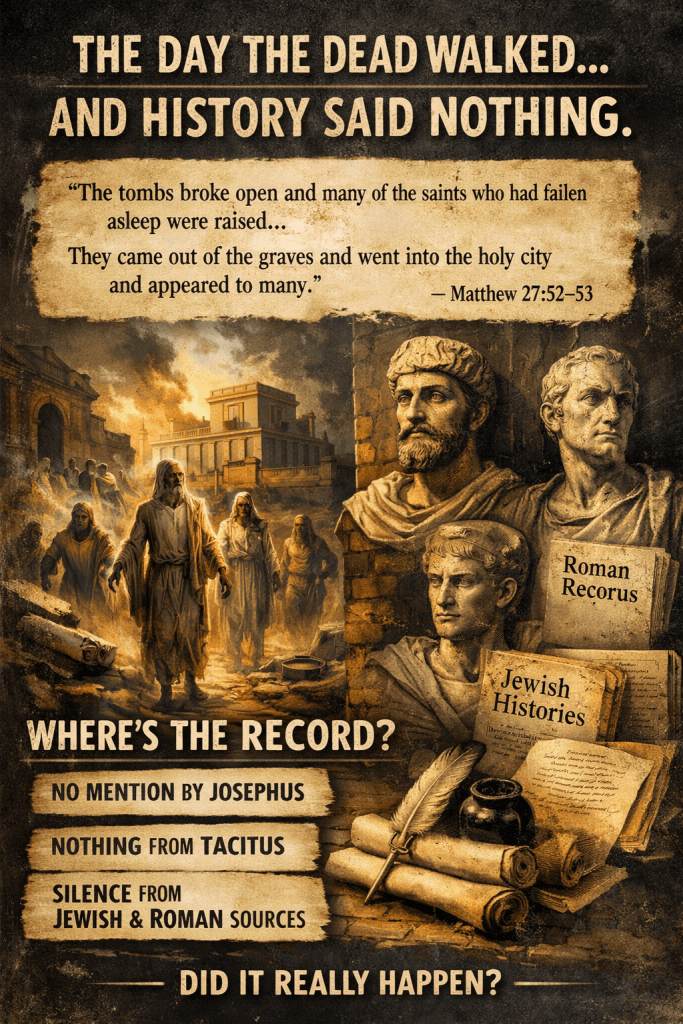
According to the Gospel of Matthew, something extraordinary happened at the moment of Jesus’ death:
Tombs broke open.
Dead saints were raised.
They came out of the graves after the resurrection and went into Jerusalem, appearing to many.
That’s not a private vision.
That’s not a metaphor about hope.
That’s a public, city-level supernatural event.
And yet, history is silent.
The Passage in Question
The claim appears only in Gospel of Matthew 27:52–53. No other gospel records it. Not Gospel of Mark, not Gospel of Luke, not Gospel of John.
Let that sink in.
An earthquake splitting tombs?
Multiple dead people walking into Jerusalem?
Appearing to “many”?
And three out of four gospel writers, silent.
Where Is the Historical Record?
Jerusalem in the first century was not an isolated village. It was:
- A religious epicenter
- A Roman-occupied city
- A politically sensitive region
- Closely monitored by Roman authorities
If graves burst open and recognizable deceased individuals were walking the streets, that would have caused:
- Religious panic
- Roman investigation
- Public unrest
- Documentation
Yet we have none.
Not from Jewish historians.
Not from Roman chroniclers.
Not from local records.
What About Josephus?
Flavius Josephus wrote extensively about:
- Unusual omens
- Political upheaval
- Messianic movements
- Strange events before the fall of Jerusalem
He records minor prophetic signs and obscure miracle claims.
But mass resurrection in Jerusalem?
Nothing.
If this happened, it would have eclipsed most of what he documented.
What About Roman Sources?
Tacitus discusses Jesus’ execution in passing.
Roman writers recorded eclipses, comets, earthquakes, rebellions.
But dead citizens walking around during Passover in a Roman-controlled city?
Total silence.
The Logical Problem
If:
- Tombs opened
- Dead saints walked visibly
- They appeared to “many”
Then this was not a small private event.
This was the kind of phenomenon that would:
- Spread through trade routes
- Reach Rome
- Be written about in Jewish polemics
- Appear in anti-Christian criticism
Instead, we get nothing outside a single paragraph in one gospel written decades later.
That’s not a minor omission.
That’s historically catastrophic.
The Apologetic Responses I Once Accepted
When I was a believer, I used to rationalize:
- “Maybe records were lost.”
- “Maybe historians ignored it.”
- “Maybe it was symbolic language.”
But that doesn’t hold up.
Josephus documented strange portents before the Temple’s destruction — including things far less dramatic than corpses walking into the city.
So either:
- He ignored the most astonishing public event imaginable
- The event was unknown outside Christian circles
- The story developed later as theological symbolism
The third option is the only one that fits the evidence.
Why This Matters
This isn’t about nitpicking details.
This is about standards of evidence.
If another religion claimed:
“At the death of our prophet, graves opened and holy men walked through the capital city appearing to many.”
Would Christians accept that without independent confirmation?
Or would they demand corroboration?
Consistency matters.
My Personal Turning Point
As someone who once defended every verse as literal history, this passage forced a shift.
Not because miracles are impossible.
But because extraordinary public events leave footprints.
This one didn’t.
And when I finally allowed myself to ask, “Why is no one else talking about this?”, the silence was louder than the story.
The Uncomfortable Question
If dead people walked through Jerusalem and no contemporary historian noticed…
Did it happen?
Or are we looking at theological storytelling shaped to amplify the cosmic significance of the crucifixion?
For me, that question marked the beginning of intellectual honesty.
And once you start asking those questions consistently, you can’t selectively stop.
 leavingfaithbehind.com
Share your thoughts