I Never Realized Genesis Begins Twice
For years, I read Genesis the way I was taught in church. Genesis 1 was the creation story, and Genesis 2 was simply a closer look at Day 6. I never questioned it because I never thought to read both chapters carefully, side by side.
But one day I did.
And for the first time, I noticed something I had somehow missed despite reading Genesis countless times.
The Bible doesn’t begin with one creation story.
It begins with two.
That simple observation sent me down a path that eventually changed the way I viewed not just Genesis, but the Bible as a whole.
Two Stories, Two Different Styles
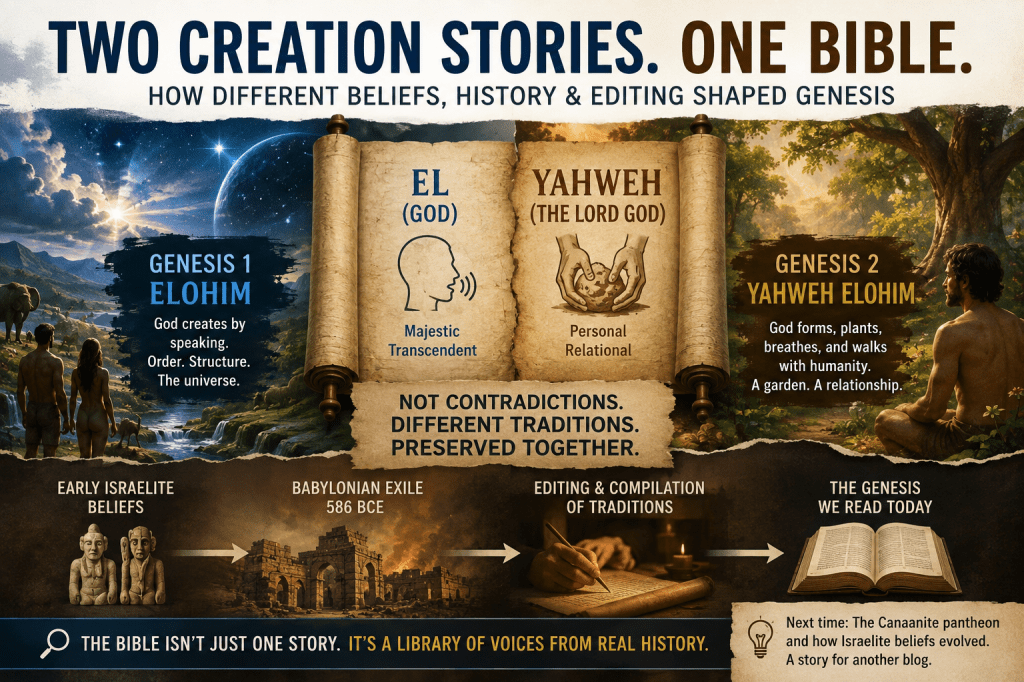
The first creation account (Genesis 1) is grand and majestic.
God simply speaks.
“Let there be light.”
Everything happens in a neat order over six days. The universe is created, followed by plants, animals, and finally humanity, male and female together.
Throughout this chapter, God is simply called Elohim (“God”).
Then Genesis 2 begins.
Suddenly everything feels different.
Now God is called Yahweh Elohim (“the LORD God”).
Instead of speaking creation into existence, He forms Adam from dust, breathes into his nostrils, plants a garden, walks through it, and personally interacts with the people He created.
Even the order of creation appears different.
It doesn’t read like the same author continuing the same story.
It reads like another storyteller.
What I Was Told as a Christian
Whenever someone pointed out these differences, I already knew the answer.
“It’s just a zoomed-in version.”
That explanation satisfied me for years because I never looked beyond it.
But once I actually compared both chapters carefully, it didn’t feel like a simple zoom-in anymore.
It felt like two separate traditions sitting next to each other.
That was a question I couldn’t ignore.
Why Are There Two Different Accounts?
As I started reading outside Christian apologetics, I discovered something I had never heard in church.
Many biblical scholars believe Genesis wasn’t written by a single person at one time.
Instead, it contains traditions that came from different groups and were later brought together.
One tradition consistently refers to God as Elohim.
Another prefers the name Yahweh.
That’s why people often refer to them as the Elohist/Priestly and Yahwist traditions.
Whether every detail of those theories is correct isn’t really the point.
The point is that Genesis itself suddenly made much more sense.
Instead of forcing the two chapters to agree perfectly, I could simply acknowledge that they came from different voices.
Why Didn’t They Just Pick One?
This became the next question I asked.
If these stories came from different traditions, why didn’t the editors remove one of them?
The answer surprised me.
They didn’t seem interested in erasing older traditions.
Instead, they preserved them.
Rather than rewriting everything into one perfectly consistent story, they allowed both voices to remain.
Ironically, that’s why we can still see the differences today.
Then I Learned About the Babylonian Exile
The more I read about ancient Israel, the more everything started fitting together.
When Babylon destroyed Jerusalem and the Temple in 586 BC, it wasn’t just a political disaster.
It was a crisis of faith.
The Israelites had to rethink who they were and how they understood God.
It was during and after this period that many of Israel’s traditions were collected, edited, and preserved.
That doesn’t mean every book was written during the exile.
But it was a period when older traditions were brought together into the forms we largely recognize today.
Knowing that historical background made the opening chapters of Genesis look much less mysterious.
Archaeology Made the Bible More Understandable
One thing I didn’t expect during my deconstruction was that archaeology would actually make the Bible easier to understand.
The archaeological evidence suggests that ancient Israel’s beliefs developed over time.
Early Israel wasn’t always the strict monotheistic religion I had imagined growing up.
Their understanding of God evolved over centuries.
When I looked back at Genesis with that in mind, I wasn’t just reading a creation story anymore.
I was reading two different traditions that reflected different stages in Israel’s history.
Suddenly the Bible wasn’t fighting against archaeology.
It was actually matching what archaeology was revealing.
I Read Genesis Differently Today
As a believer, I always assumed Genesis was supposed to answer one question:
“How did God create the world?”
Today I think it tells another story as well.
It shows us how ancient Israel understood God at different points in its history.
One author describes a majestic Creator who speaks the universe into existence.
Another describes a deeply personal God who forms humanity with His hands and walks in a garden.
Instead of asking which account is “correct,” I now find myself asking why both were preserved.
Ironically, that question taught me more about the Bible than years of trying to harmonize every verse ever did.
The Beginning of a Different Way of Reading
I don’t read Genesis today looking for hidden explanations that make every verse fit together perfectly.
I read it as an ancient collection of writings shaped by real people, living through real history, trying to understand God in the world they lived in.
For me, that doesn’t make the Bible less fascinating.
It makes it more human.
And strangely enough, the more I learned about archaeology and the history of ancient Israel, the more the Bible itself began to make sense. Instead of seeing contradictions as problems to explain away, I started seeing them as clues that pointed to the Bible’s own history.
This was one of the first moments in my deconstruction where I stopped asking, “How do I make these two stories agree?” and started asking, “Why are both stories here in the first place?”
That single question changed the way I read the rest of the Bible.
In a future post, I’ll go one step further. I’ll explore the Canaanite pantheon, who El and Yahweh were in the religious world of the ancient Near East, and how archaeology suggests Israelite religion evolved over time rather than appearing fully formed. It’s a fascinating journey that helps explain not only the opening chapters of Genesis, but many of the shifts we see throughout the Old Testament.
Because sometimes the most interesting question isn’t whether the Bible changed history.
It’s whether history changed the Bible.


Share your thoughts