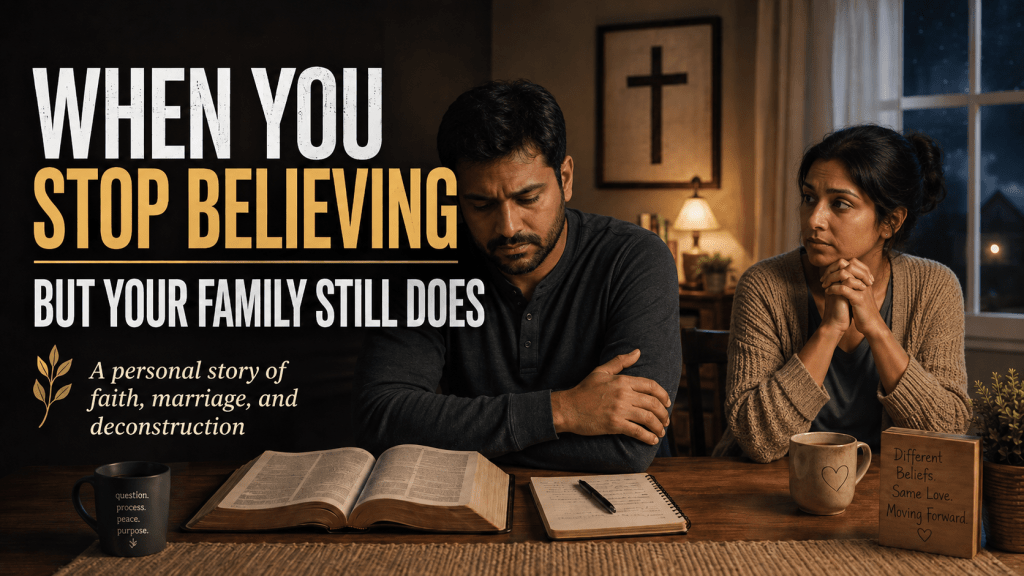
There was a time when losing my Christian faith felt difficult enough on its own.
Then I realized I also had to face something even harder:
What happens when the people you love still believe everything you no longer can?
For me, this was not an abstract question.
It was my marriage.
My Marriage Was Built Around Faith
Christianity wasn’t simply one part of my relationship with my wife. It was one of the reasons we chose each other.
Before we married, my wife asked me something that mattered deeply to her:
Would I pray with her? Would I support her spiritually? Would I walk with her in faith throughout our life together?
I promised that I would.
And I meant it.
I wasn’t pretending. I wasn’t secretly doubting Christianity while making that commitment.
I genuinely believed.
I imagined us praying together, growing spiritually together and remaining committed to Christ throughout our lives.
So when my faith eventually began falling apart, I wasn’t only questioning Christianity.
I felt as though I was breaking a promise I had made to the person closest to me.
I Didn’t Want to Lose Jesus
My doubts didn’t begin with me wanting to become an atheist or trying to prove Christianity false.
Quite the opposite.
For a long time, I desperately wanted something to remain.
Even when I began questioning the Bible, I remember thinking:
What if the Bible isn’t completely reliable, but Jesus is still God?
I wanted Jesus to survive my doubts.
There were nights when I cried privately and asked Jesus for something, anything.
A dream.
A sign.
Some unmistakable reassurance that he was still there.
I wasn’t demanding a miracle to show off to other people.
I simply wanted enough reason to keep believing.
But I heard nothing.
Only silence.
And that silence became harder to explain as I continued searching.
The More I Investigated, the More the Story Changed
I began looking at Christianity differently.
Instead of asking, “How can I defend this?”, I started asking:
“Is this actually true?”
I began reading about how the Gospels were written, their anonymous authorship in the texts themselves, their Greek literary setting, the differences between the Gospel accounts, the order in which they were probably written, and how their stories compared with what we can establish historically.
Slowly, the picture I had carried for years began changing.
Christianity ultimately rests on one central story:
Jesus is crucified.
Jesus dies for sin.
Jesus rises from the dead.
Everything depends on that story being true.
But the more I studied how that story developed in the texts, the harder it became for me to separate the historical Jesus from the theological Jesus constructed by the Gospel writers.
Eventually, I reached a conclusion I never wanted to reach:
I could no longer believe in Jesus in the way I once had.
That conclusion didn’t feel like freedom at first.
It felt like loss.
Then I Had to Tell My Wife
This was one of the hardest conversations I have ever had.
For me, the change had happened slowly.
I had spent months thinking, reading, questioning and emotionally processing what I was discovering.
But for my wife, all of that arrived almost at once.
The person she had married partly because of our shared Christian faith was now telling her that he no longer believed.
I could see what it meant to her.
It wasn’t merely:
“My husband changed his opinion about religion.”
It felt much bigger.
The spiritual future she imagined for our marriage had suddenly changed.
The person who had promised to pray with her and walk beside her spiritually was telling her that he no longer believed the foundation beneath those promises was true.
What she probably thought could never happen in our family had happened.
And there was very little I could say that would make that painless.
I Realized Explaining More Wasn’t Always Helping
My instinct was to explain everything.
The Gospel problems.
Biblical contradictions.
Historical questions.
Why certain arguments no longer convinced me.
I wanted her to understand that I hadn’t simply become careless, rebellious or spiritually lazy.
But then something became obvious.
The more I explained, the more I was hurting her.
Because I remembered exactly how I used to think.
If someone had approached the old version of me and dismantled everything I believed about Christianity, I wouldn’t have calmly examined every argument.
I would have felt threatened.
I would have defended my faith.
I might even have felt that the person was trying to take God away from me.
Once I put my old self in my wife’s position, I understood something important:
She didn’t need me to make her stop believing.
And I didn’t need her permission to stop believing.
Those are two very different things.
We Didn’t Need to Believe the Same Thing to Remain Family
Eventually, we stopped trying to solve the religious difference every time it appeared.
We began focusing on something much larger.
Everything else we shared.
Our relationship.
Our history.
Our family.
Our responsibilities.
The things we enjoy.
The ordinary conversations.
The plans we make.
The life we have built together.
Christianity had once been one of our biggest common grounds.
Losing that common ground hurt.
But it turned out that our marriage contained much more than Christianity.
We didn’t have to destroy everything else simply because one part of our relationship had changed.
That became incredibly important to me.
You Don’t Have to Deconvert Your Family
If you’re secretly questioning Christianity while your spouse, parents or family remain deeply religious, you may feel enormous pressure to explain yourself.
You may think:
If only they understood what I discovered, they would understand me.
Maybe they will eventually.
Maybe they won’t.
But trying to force someone through your entire deconstruction journey usually doesn’t work.
You probably reached your current position after hundreds of questions, thoughts, experiences and discoveries.
You cannot compress that journey into one conversation and expect someone else to arrive at the same conclusion.
And you don’t have to.
Your family doesn’t need to agree with every conclusion you have reached in order for you to love them.
Likewise, you don’t have to pretend to believe something you no longer believe simply to keep everyone comfortable.
There is a difficult middle ground between those two extremes.
That is where I am learning to live.
Losing Faith Doesn’t Mean Losing Everyone
One of the fears during deconstruction is that everything will collapse together.
God.
Church.
Identity.
Marriage.
Family.
Community.
Your entire future.
Sometimes relationships unfortunately do break under that pressure.
Religious differences can expose serious problems, especially when one person believes the other must return to faith at any cost.
But disagreement doesn’t automatically mean the relationship has to end.
In my own marriage, I eventually stopped seeing the goal as:
“How do I make my wife understand why Christianity isn’t true?”
The better question became:
“How do we continue loving each other when we now understand one important part of life very differently?”
That question changed the conversation.
If You’re Secretly Going Through This
If you are reading this while secretly questioning your faith, particularly while living with a deeply believing spouse or family, I know why you may be afraid to speak.
You may be imagining every possible consequence.
You may even be continuing prayers, church routines or religious conversations while internally wondering whether you believe any of it anymore.
You do not have to solve your entire future today.
Your questions are allowed to remain questions while you work through them.
And when the time comes to speak with the people closest to you, remember that they may experience your change very differently from the way you experienced it.
You had time to slowly process your doubts.
They may hear the final conclusion before they’ve heard any of the journey.
That difference matters.
Sometimes the most loving thing isn’t giving them another argument.
Sometimes it is giving them time.
I Am Not the Same Person She Married — But I Am Still Her Husband
I cannot honestly become the Christian man I was simply because that version of me would make life easier.
Once I saw Christianity differently, I couldn’t force myself to unknow what I had learned.
But one thing did not disappear with my faith.
My commitment to my wife.
The religious meaning behind some of the promises I made may have changed, but the person I made those promises to is still here.
So am I.
We have chosen to find the many places where our lives still meet rather than allowing the one place where they now differ to consume everything else.
I don’t know how every family should handle deconstruction.
But I know this:
You do not have to choose between intellectual honesty and loving your family.
You can stop pretending.
You can allow the people you love to continue believing.
And you can build a relationship around more than theological agreement.
For me, leaving faith behind did not mean leaving my family behind.
It meant learning how to love them without requiring them to follow me out.
If you are questioning your faith while your spouse or family still believes, what has been the hardest part for you? Have you told them yet, or are you still carrying it alone? Share your experience in the comments. You may find that more people are living through this than you realize.


Share your thoughts