There is one statement of Jesus that I read many times as a believer without ever allowing myself to take it at face value:
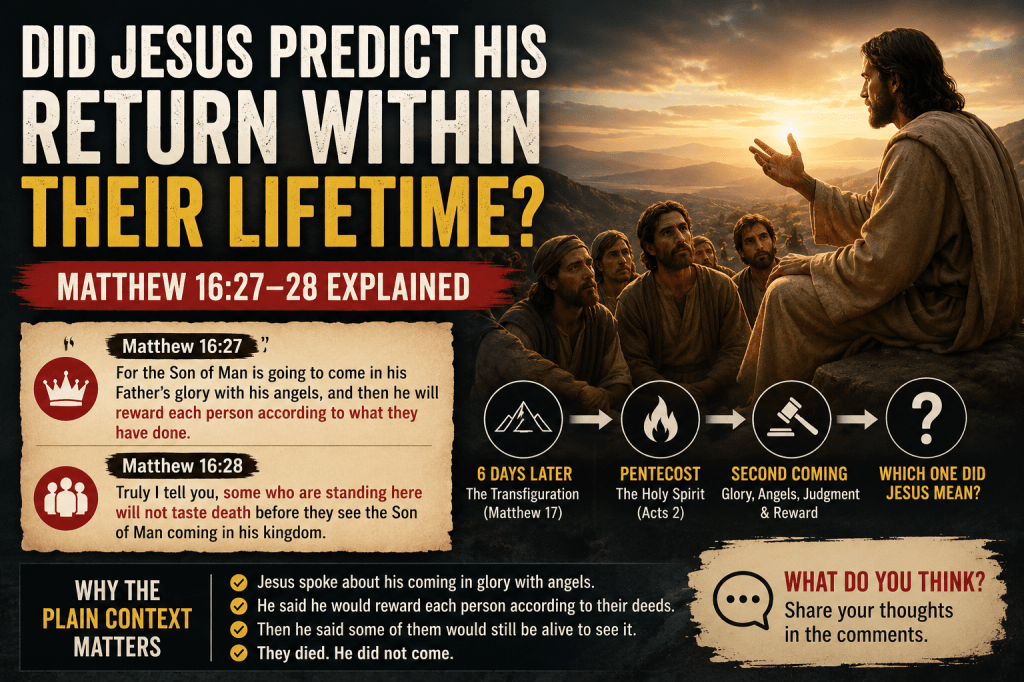
“Truly I tell you, some who are standing here will not taste death before they see the Son of Man coming in his kingdom.” — Matthew 16:28
For years, I was told that this verse did not mean Jesus would return during the lifetime of those standing in front of him.
But when I began reading the passage without first assuming that Jesus could not have been wrong, the meaning suddenly seemed much more straightforward.
Read the Previous Verse First
Matthew 16:28 should not be read by itself.
Immediately before it, Jesus says:
“For the Son of Man is going to come in his Father’s glory with his angels, and then he will reward each person according to what they have done.” — Matthew 16:27
Then comes the very next sentence:
“Some who are standing here will not taste death before they see the Son of Man coming in his kingdom.”
The context seems clear.
Jesus is talking about the coming of the Son of Man in glory, accompanied by angels, when people will be rewarded according to their deeds.
In other words, this sounds exactly like what Christians normally call the Second Coming.
And Jesus immediately tells the people standing in front of him that some of them will still be alive when it happens.
That is what bothered me once I started reading the passage plainly.
The Transfiguration Explanation
The most common Christian explanation I heard was that Jesus was referring to the Transfiguration.
The argument is simple.
Matthew 17 begins by saying that six days later, Jesus took Peter, James and John up a mountain. There Jesus was transfigured before them and appeared in glory.
Only some of the disciples witnessed it.
Therefore, Christians argue, Jesus’ statement that “some who are standing here” would see the Son of Man in his kingdom was fulfilled six days later.
As a believer, I accepted that explanation.
Today, I think it creates more problems than it solves.
Where Was the Judgment?
The first problem is the context.
Jesus had just said that the Son of Man would come with angels and reward everyone according to their deeds.
Did that happen at the Transfiguration?
No.
Jesus’ appearance changed.
Moses and Elijah appeared.
Peter, James and John witnessed it.
Then they came back down the mountain.
Nobody was judged.
Nobody was rewarded according to their deeds.
The coming described in verse 27 simply did not happen.
The Transfiguration may have been a demonstration or preview of Jesus’ glory, but a preview of something is not the same as the event itself.
If verse 27 describes the Second Coming, it makes little sense to suddenly redefine verse 28 as an unrelated mountain experience.
“Some of You Will Not Die” — For Six Days?
There is another problem that became obvious to me once I thought about it.
If Jesus was really referring to the Transfiguration, he was effectively saying:
“Some of you standing here will still be alive six days from now.”
Why would that need to be said?
Imagine telling a group of healthy adults:
“Some of you will not die before next Tuesday.”
Of course they probably won’t.
The statement only carries real weight if the event is far enough into the future that some of the audience may die before it happens.
I am not saying Jesus predicted that most of his disciples would die within six days.
The point is that the phrase “will not taste death before…” sounds completely unnecessary if he was talking about an event less than a week away.
But it makes perfect sense if Jesus believed something major would happen within the lifetime of his generation.
What About Pentecost?
Other Christians say Jesus was referring to Pentecost.
Others suggest his resurrection, the growth of the Church, the destruction of Jerusalem in 70 CE, or some spiritual arrival of the Kingdom.
But the same problem remains.
Where, in those events, is the Son of Man coming in his Father’s glory with angels and rewarding each person according to their deeds?
Whenever the New Testament talks about Jesus coming with judgment and reward, Christians normally understand it as his future return.
Revelation even uses similar language: Jesus says he is coming soon and that his reward is with him to repay each person according to what they have done.
Yet when almost identical ideas appear in Matthew 16, suddenly the meaning has to become something else.
Why?
For me, the answer became uncomfortable.
Because if the passage means what it appears to mean, the prediction failed.
I Had Seen This Problem Before
I have already written about Jesus saying:
“This generation will not pass away until all these things have happened.”
That earlier post explored another side of the same issue: the repeated sense of urgency surrounding Jesus’ expected return.
Matthew 16:28 adds another piece.
Here Jesus doesn’t just say “this generation.”
He speaks directly to the people standing in front of him.
Some of you will still be alive when this happens.
That seems much harder to push thousands of years into the future.
As a believer, I started with one assumption:
Jesus could not have been wrong.
So whenever a passage appeared to suggest otherwise, I looked for another interpretation.
Transfiguration.
Pentecost.
Resurrection.
Jerusalem.
A spiritual kingdom.
There was always another explanation.
But eventually I asked myself a question I had never seriously considered:
What would I think if these words had been spoken by the founder of another religion?
If another religious teacher said that some of the people standing in front of him would still be alive when he returned in supernatural glory to judge humanity and they all eventually died without that happening – would I search for symbolic fulfillments?
Or would I simply say that the prediction did not come true?
Maybe the Plain Meaning Is the Difficult Meaning
Today, Matthew 16:27–28 doesn’t seem especially mysterious to me.
Jesus speaks about the Son of Man coming in glory with angels and rewarding people according to their deeds.
Then he tells his listeners that some of them will still be alive when they see that coming.
The people standing there eventually died.
The event described in verse 27 did not happen during their lifetime.
The Transfiguration explanation removes the judgment and reward from the context. Pentecost does the same. And turning “some of you will not taste death” into a prediction about something happening only six days later makes the statement strangely pointless.
My earlier post on “this generation” made me question whether Jesus really expected people two thousand years later to still be waiting for his return.
Matthew 16:27–28 gives me another reason to think he didn’t.
Maybe Jesus really did expect the coming of the Son of Man within the lifetime of at least some of his listeners.
And maybe the many later interpretations exist because Christianity had to explain why that expectation was not fulfilled.
What do you think? When you read Matthew 16:27–28 in its plain context, do you think Jesus was talking about the Transfiguration, Pentecost, or his Second Coming? Leave your thoughts in the comments.
 leavingfaithbehind.com
Share your thoughts