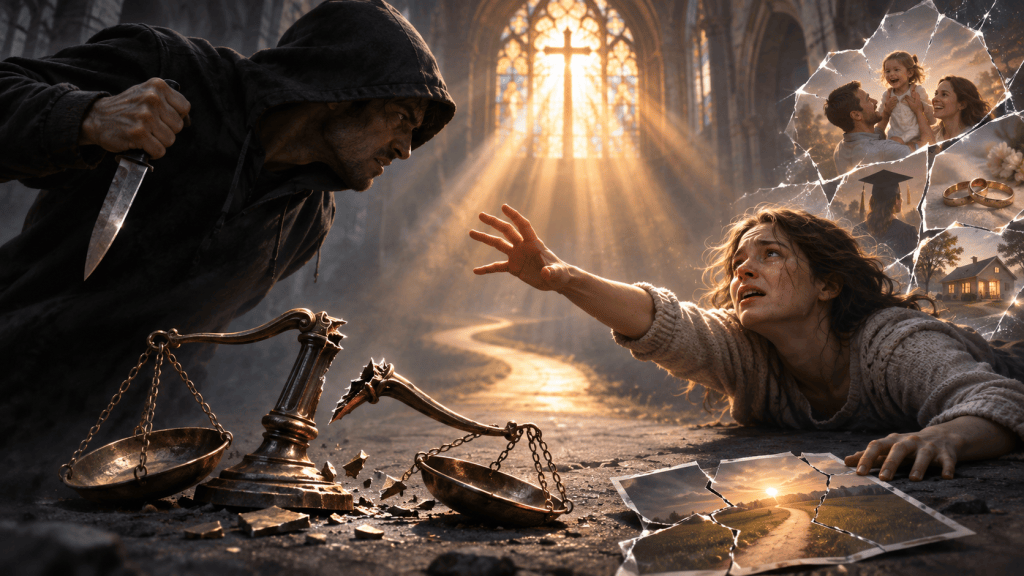
One of the most common Christian answers to the problem of evil is free will.
Why does God allow murder, rape, abuse, torture and other horrific crimes?
Because God gave human beings free will.
If God constantly stopped people from making evil choices, Christians argue, then we would not really be free. We would be like robots programmed to obey. Real love, real goodness and real faith supposedly require the possibility of choosing the opposite.
I accepted this explanation for years.
It sounded reasonable.
But eventually one question started bothering me:
What about the free will of the victim?
The Murderer Has Free Will. What About the Person Who Wants to Live?
Imagine someone decides to murder an innocent person.
The victim does not want to die.
They may have children depending on them.
A spouse waiting for them.
Parents who love them.
Dreams they haven’t fulfilled.
Plans for tomorrow.
Their own choices about how they want to live their life.
Yet another person uses his “free will” to take all of that away permanently.
When we ask why God didn’t intervene, the usual answer is:
“God cannot interfere every time someone uses free will badly.”
But why not?
If God stops the murderer, has he really destroyed the murderer’s free will?
The murderer still chose murder.
He still formed the intention.
He still acted upon that intention.
God would simply have prevented him from successfully destroying someone else’s life.
We already understand this distinction in ordinary life.
If I see someone about to stab a child and I grab his arm, I haven’t somehow denied the existence of his free will.
He freely chose to attack the child.
I simply stopped him from succeeding.
In fact, we would consider me morally responsible if I had the ability to save that child easily and simply stood there watching.
So why does that moral standard suddenly change when the observer is God?
Whose Freedom Is God Protecting?
This is where the free-will defense began to feel backwards to me.
The criminal’s freedom to act must apparently be protected.
But the victim’s freedom to continue living can be destroyed.
The murderer gets to exercise his choice.
The person being murdered loses every future choice they could ever have made.
So whose freedom actually received greater protection?
The person choosing evil?
Or the person desperately choosing to live?
This isn’t saying that God personally forces the victim to die.
The criminal is responsible for the crime.
But if an all-powerful God is present, knows exactly what is happening, has the ability to stop it effortlessly, and deliberately chooses not to intervene because he must respect human freedom, then the question remains:
Why does respecting the perpetrator’s freedom justify allowing him to erase the victim’s freedom altogether?
“God Will Punish Him Later”
Another answer I often heard was that justice will eventually happen.
The murderer may escape justice here, but nobody escapes God’s judgment.
One day he will stand before God.
But even that creates uncomfortable questions.
What good does punishment after death do for the murdered child?
It doesn’t restore the childhood that was taken.
It doesn’t prevent the parents’ suffering.
It doesn’t undo the terror.
It doesn’t give the victim back the decades of life they might have lived.
And Christian theology adds another strange possibility.
If the murderer genuinely repents and accepts Jesus before death, Christianity teaches that he can be forgiven.
Meanwhile the victim may have died without believing.
Depending on the Christian tradition, that creates a situation where the murderer could ultimately receive eternal salvation while his unbelieving victim does not.
At that point, saying “God will sort everything out later” doesn’t really answer the moral question.
The question is why a loving and powerful God allowed preventable suffering in the first place.
Preventing an Action Is Not Removing Free Will
I think this distinction is often ignored.
God would not need to remove someone’s ability to choose evil in order to prevent every evil choice from reaching its worst possible consequence.
A person could decide to shoot someone.
The gun could misfire.
A passerby could arrive.
The victim could escape.
The attacker could suddenly lose consciousness.
Any number of events could stop the murder while leaving the murderer’s moral choice completely intact.
Christians already believe God sometimes intervenes this way.
People testify that God protected them from accidents.
God caused them to miss a flight.
God sent someone at exactly the right moment.
God miraculously protected a child.
God answered a prayer for safety.
But that creates another problem.
If intervention doesn’t violate free will in those cases, why would intervention violate free will when it is desperately needed somewhere else?
You can’t have it both ways.
Either God can intervene without destroying free will, or every story about divine protection becomes difficult to explain.
We Interfere With Evil All the Time
There is another reason this argument troubles me.
Human society is built around restricting what people can do to other people.
Police stop crimes.
Parents stop children from hurting each other.
Courts imprison dangerous people.
Schools restrain violent students.
We install locks.
We create laws.
We physically intervene when someone attacks another person.
None of us seriously argues:
“Don’t stop him. You must respect his free will.”
Quite the opposite.
We believe freedom has limits when exercising your freedom destroys somebody else’s rights.
If a police officer watched a murder happen and said, “I could have stopped him, but I didn’t want to interfere with his free choice,” nobody would praise the officer’s respect for free will.
We would be horrified.
Yet when the same question is applied to God, the very thing we would condemn in a human being becomes part of a theological defense.
That inconsistency became difficult for me to ignore.
And Free Will Doesn’t Explain Everything Anyway
Even if the free-will argument completely explained human violence, it would still leave another huge part of the problem untouched.
Earthquakes don’t have free will.
Cancer doesn’t have free will.
A newborn baby dying from disease isn’t the result of that baby’s moral choices.
Floods, genetic disorders and countless forms of suffering occur without any human attacker whose freedom needs protecting.
So free will was never a complete answer to the problem of suffering anyway.
At best, it attempts to explain one category of evil:
evil caused by human choices.
And even there, I no longer think it solves the problem.
What I Used to Believe
When I was a Christian, I thought free will was one of the strongest answers we had.
God loved us too much to turn us into robots.
Therefore he had to allow us to choose good or evil.
I still understand why that idea appeals to believers.
The problem appeared when I stopped thinking only about the person making the evil choice and started thinking about the person on the receiving end of that choice.
A murderer may freely choose murder.
But the victim freely chooses life.
An abuser chooses abuse.
The victim chooses not to be abused.
A kidnapper chooses to imprison someone.
The victim chooses freedom.
Why should one person’s free choice automatically be allowed to overpower another person’s?
And why would an all-powerful, loving God be morally unable to step between them?
The Question I Couldn’t Shake
Eventually the problem became very simple for me.
If I had the power to prevent the brutal murder of an innocent child without harming myself, I would do it.
I think almost every decent human being would.
And if I deliberately watched it happen while having unlimited power to stop it, nobody would call my inaction loving.
They certainly wouldn’t excuse me by saying:
“He was respecting the murderer’s free will.”
So why should that explanation become satisfactory when we replace the observer with God?
Maybe free will explains why human beings can want to do evil.
But I don’t think it explains why an all-powerful God must allow every evil intention to become reality.
And once a person’s free choice is allowed to destroy another person’s entire future, I find it very difficult to say that this arrangement exists because God values human freedom.
It seems to protect the freedom of the aggressor while leaving the victim to pay the price.
What do you think? Does the free-will defense actually explain why God allows horrific crimes, or does asking about the victim’s freedom create an even bigger problem? Share your thoughts in the comments.


Share your thoughts